The best lotion for thigh acne and breakouts is usually a moisturizing leave-on treatment that combines chemical exfoliation with barrier support, not a harsh acne lotion designed simply to dry out oil. Look for keratolytic ingredients such as lactic acid and salicylic acid, especially if the bumps are small, rough or centered around hair follicles.
There is one catch. “Thigh acne” is a useful search term, but it is not a diagnosis. Before choosing a lotion, you need a decent idea of what those bumps actually are.
What Is Thigh Acne, Exactly?
What people call thigh acne can be several different things: true acne, keratosis pilaris, folliculitis, ingrown hairs or irritation around the follicle.
That distinction matters more than the word on the bottle.
True acne involves abnormal follicular keratinization, inflammation and sebum. But the thighs are also an extremely common location for keratosis pilaris, where keratin accumulates around the follicle and creates those tiny rough plugs that can look almost exactly like small pimples.
Folliculitis can fool you too. It is inflammation of the hair follicle, sometimes associated with bacteria or yeast, and it can produce red or pus-filled bumps that look remarkably acne-like. Shaving can add another variable by producing ingrown hairs and irritated follicles.
So if you have twenty nearly identical tiny bumps scattered across the fronts or outer portions of your thighs, immediately treating them like oily facial acne may make very little sense.
Sometimes the issue is keratin, not oil.
What Ingredients Should Be in a Lotion for Thigh Breakouts?
For small follicular bumps, rough texture and KP-prone thighs, I look first for keratolytic exfoliants in an actual moisturizing base.
Keratolytic simply means the ingredient helps loosen and normalize excess keratin at the surface and around the follicle. That is exactly where many thigh-bump problems start.
Lactic acid
Lactic acid is an alpha hydroxy acid, or AHA, and it is one of my favorite body-skin ingredients because it does two jobs particularly well.
It exfoliates, but it is also compatible with a moisturizing treatment strategy. That distinction is important on thighs, where excessive stripping can leave the skin dry, tight and even more visibly textured.
Lactic-acid-containing moisturizers are commonly used for keratosis pilaris for precisely this reason. You are not trying to sand the bump off. You are gradually changing how compacted surface cells release while keeping the surrounding skin comfortable.
And yes, that takes consistency.
Salicylic acid
Salicylic acid is a beta hydroxy acid, or BHA. It is particularly useful when there is obvious follicular congestion because it helps exfoliate within the follicular environment as well as across the skin surface.
For thighs with a mixture of rough bumps, occasional inflamed follicles and ingrown-prone areas, a well-formulated salicylic acid lotion can make more sense than a product that only moisturizes.
But more acid is not automatically better. A formula that leaves the thigh flaky and irritated is not winning simply because the ingredient deck looks aggressive.
Moisturizing ingredients matter more than people think
A thigh-breakout treatment should still behave like skincare.
Humectants help hold water in the stratum corneum. Emollients improve flexibility and smoothness. A properly constructed lotion also reduces the cycle in which someone sees bumps, scrubs harder, dries the skin out, sees more roughness and then scrubs again.
That cycle is remarkably common.
Barrier support is not the opposite of treating breakouts. On body skin, it is often part of treating them intelligently.
Is Lactic Acid or Salicylic Acid Better for Thigh Acne?
Lactic acid is especially useful for rough, dry, KP-like bumps, while salicylic acid is particularly useful for follicular congestion. A formula containing both can make sense when thigh breakouts include a mixture of rough texture and clogged follicles.
I would not reduce this to “AHA versus BHA, pick one.”
Skin does not read ingredient marketing charts.
If the thigh feels like sandpaper and the bumps are numerous, uniform and relatively small, I want to think about excess keratin and moisture simultaneously. Lactic acid fits that situation beautifully.
If you have more obvious clogged follicular openings or ingrown-prone areas, salicylic acid becomes especially interesting.
And if your skin is doing both? That is common enough that combining chemical exfoliation mechanisms in a tolerable lotion is perfectly rational.
The key word is tolerable. An active only works if you can actually keep using it.
Why Do Face Acne Products Often Disappoint on the Thighs?
Because the problem you are treating may not be facial-type acne in the first place.
Facial acne frequently occurs in highly sebaceous areas. That is why so much traditional acne language revolves around oil control, shine, clogged pores and treatments that can be fairly drying.
Thigh skin presents a different landscape.
A person may have virtually no oiliness on the thighs and still have hundreds of visible follicular bumps. If those bumps are KP, irritated follicles or shaving-related ingrowns, aggressively stripping sebum does not solve the underlying problem. There may not be excess sebum to solve.
This is where body skincare gets unnecessarily crude. People will use sophisticated barrier serums on their cheeks, then attack their thighs with an abrasive scrub and the strongest acne wash they can find.
The thigh is still skin.
If the follicular barrier is already irritated from shaving, clothing friction or over-exfoliation, repeatedly drying it out can create more discomfort and make the overall texture look worse.
Treat the follicle. Keep the barrier functional.
You can do both.
Can Moisturizer Actually Help Thigh Breakouts?
Yes, especially when the bumps involve keratin buildup or keratosis pilaris.
Moisturization is not just cosmetic camouflage for dry skin. Water content changes the physical behavior of the stratum corneum. Hydrated keratin is more flexible than dry, compacted keratin, which is one reason moisturizing keratolytic formulas are so useful for rough follicular conditions.
This is also why I prefer the idea of an exfoliating lotion over treating thigh texture with exfoliation in isolation.
You get controlled chemical exfoliation while supporting the skin around the follicle at the same time.
One small formulation detail makes a big practical difference here: a treatment needs enough slip and emollience to spread over an entire thigh without requiring vigorous rubbing. If applying your “acne treatment” feels like dragging paste across dry skin, the user experience is already fighting the biology.
Is Thigh Acne Actually Keratosis Pilaris?
Sometimes. Keratosis pilaris is especially common on the thighs and upper arms, and its keratin plugs can look like tiny pimples.
A quick visual clue is uniformity. KP often creates many small, similar-looking follicular bumps and a rough or gooseflesh-like texture. There may also be redness around individual follicles.
Inflamed folliculitis can look more obviously angry. You may see red rings around individual follicles, tenderness, itching or pustules.
Ingrown hairs have their own personality. They often appear after shaving or waxing and may be larger, more isolated or visibly associated with a trapped hair.
None of those visual clues replaces an actual diagnosis. If your bumps are painful, rapidly spreading, draining, repeatedly forming deep nodules or leaving significant scars, stop experimenting with body lotions and see a dermatologist. Recurrent deep painful lesions in the groin or inner-thigh folds also deserve medical evaluation because conditions such as hidradenitis suppurativa require a completely different treatment approach.
What About Folliculitis on the Thighs?
A lotion can improve follicular buildup and the surrounding barrier, but true infectious folliculitis may require treatment directed at its cause.
That is an important limitation.
Folliculitis is not one single organism and one single treatment. Bacteria can be involved. Yeast can be involved. There are also noninfectious forms of follicular inflammation.
So I would be suspicious of any cosmetic lotion claiming to solve every case of “folliculitis.”
What skincare can do extremely well is reduce some of the conditions that make thigh follicles troublesome in the first place: compacted surface keratin, roughness, excessive abrasion and a compromised skin barrier.
If pustules keep returning despite good skincare, get them evaluated. Sometimes a clinician needs to culture or otherwise assess persistent folliculitis rather than guessing from appearance alone.
Does Friction Cause Thigh Breakouts?
Friction can absolutely aggravate follicular skin, especially on inner thighs and under tight clothing, but “friction causes acne” is too simplistic.
Think about a long workout in compression shorts. The skin stays warm and occluded, the fabric moves repeatedly against the same follicles, and sweat remains against the surface until you change clothes. That environment can aggravate irritation and folliculitis-prone skin.
The answer is not to scrub harder afterward.
Change out of damp clothing. Clean the skin. Then treat it gently and consistently.
If your skin repeatedly breaks out exactly where the seam of your leggings sits, that is useful information.
Should You Scrub Thigh Acne?
Not aggressively.
There are two ways to exfoliate body skin: physical exfoliation and chemical exfoliation. Both can be useful, but they should not be confused with abrasion for abrasion's sake.
Chemical exfoliants such as lactic acid and salicylic acid loosen compacted cells through their chemical activity.
A physical exfoliant removes surface buildup through contact.
The mistake is assuming that more friction produces more clearing. If you are using a gritty scrub until the skin turns pink, you have moved beyond productive exfoliation into irritation. Already inflamed follicles do not need that.
I prefer frequent, gentle exfoliation to an occasional assault with apricot pits, salt crystals or an aggressively textured cloth.
Your barrier should still be intact when you are finished.
Should You Use a Lotion Every Day?
A well-tolerated body lotion can often be used daily, but the right frequency depends on the strength and combination of active ingredients.
With any exfoliating lotion, pay attention to the skin rather than treating redness as proof that something is working.
Persistent burning is not “purging.” Neither is shiny, tight skin.
If you are new to acids or already sensitive from shaving, start less frequently and build toward regular use as tolerated. The goal is steady normalization of follicular buildup. You do not get extra credit for reaching irritation faster.
And apply enough product to actually cover the area. Spot-dabbing twenty individual thigh bumps misses the fact that follicular roughness often exists across the whole field of skin.
How Long Does It Take for a Thigh Acne Lotion to Work?
Expect texture to change gradually over several weeks rather than overnight, particularly if keratosis pilaris is part of the picture.
Individual inflamed bumps can come and go much faster. Follicular keratinization is different. You are repeatedly influencing how cells accumulate and release from thousands of follicles, and that process requires consistency.
KP is also a condition that is managed rather than permanently cured. Stop the routine and the rough follicular texture can return.
That is another reason tolerability matters so much. The “strongest” lotion used for four irritated days is less useful than a well-designed exfoliating moisturizer you are comfortable using for months.
What Should You Avoid in a Lotion for Thigh Breakouts?
I would avoid choosing a product based solely on how medicinal, tingling or drying it feels.
A high alcohol load is not evidence of efficacy. Neither is a menthol sting.
I also would not obsess over finding a completely oil-free formula simply because the word “acne” is involved. “Comedogenic” ingredient lists are a notoriously clumsy way to predict how a finished formula will behave, and the thigh is not an oily T-zone.
Look at the formula's job instead.
Does it exfoliate follicular buildup? Does it moisturize? Can you spread it comfortably over body skin? Can you use it consistently without making your skin angry?
Those questions are more useful.
What Is the Best Routine for Thigh Acne and Breakouts?
Start with gentle cleansing and physical exfoliation in the shower, then apply your chemical exfoliating lotion to dry skin.
The sequence makes sense mechanically. A light physical exfoliation step removes loose surface buildup first. The leave-on chemical exfoliant then has direct contact with skin instead of being applied over a heavy layer of compacted surface cells.
But the word light matters.
You are not trying to scrape keratin plugs out of individual follicles. Think controlled surface polishing followed by chemical exfoliation and moisturization.
For a newly inflamed individual bump, leave it alone rather than squeezing it. Trauma to one tiny follicle can turn a forgettable bump into weeks of post-inflammatory discoloration.
Can Thigh Breakouts Be Prevented?
Not every thigh bump is preventable, especially if you are genetically prone to keratosis pilaris, but you can reduce several common triggers.
Keep exfoliation consistent rather than episodic. Avoid repeatedly traumatizing the same follicles. Change out of sweaty clothes after exercise. If shaving clearly triggers bumps, look closely at your hair-removal technique and frequency.
Most of all, do not wait until the thighs feel rough and congested and then try to erase six weeks of buildup in one shower.
Follicular skin responds better to maintenance.
Hot people exfoliate. They just don't sandblast themselves.
THE SKINBOSS PERSPECTIVE
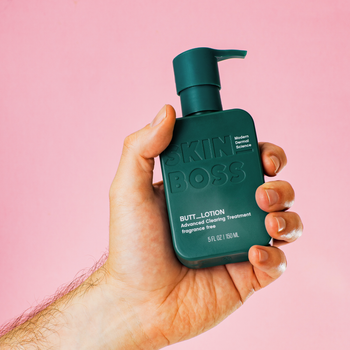
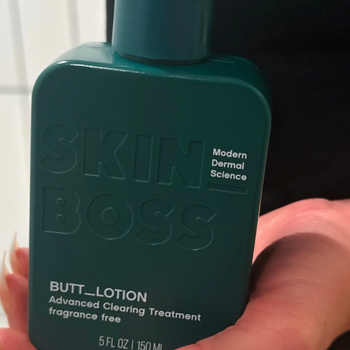
The smartest thigh-breakout routine treats follicular buildup and the barrier at the same time, instead of importing drying face-acne logic to body skin. THE LUXE LOOP™ provides the gentle physical exfoliation step, then THE BUTT ACNE TREATMENT™ follows as the chemical exfoliant and moisturizer with salicylic acid + Lactiv® Complex; THE PEACH PATCH™ can be used as the treatment for an individual body breakout. Physical first, chemical second, no harsh scrubbing, and no requirement that healthy skin feel stripped in order to look clearer.
References
- American Academy of Dermatology Association / Keratosis pilaris: Self-care — https://www.aad.org/public/diseases/a-z/keratosis-pilaris-self-care
- American Academy of Dermatology Association / Keratosis pilaris: Diagnosis and treatment — https://www.aad.org/public/diseases/a-z/keratosis-pilaris-treatment
- American Academy of Dermatology Association / Keratosis pilaris: Overview — https://www.aad.org/public/diseases/a-z/keratosis-pilaris-overview
- American Academy of Dermatology Association / Acne-like breakouts could be folliculitis — https://www.aad.org/public/diseases/a-z/folliculitis
- American Academy of Dermatology Association / 12 summer skin problems you can prevent — https://www.aad.org/public/everyday-care/skin-care-secrets/routine/prevent-summer-skin-problems
- Mayo Clinic / Folliculitis: Symptoms and causes — https://www.mayoclinic.org/diseases-conditions/folliculitis/symptoms-causes/syc-20361634
- Mayo Clinic / Folliculitis: Diagnosis and treatment — https://www.mayoclinic.org/diseases-conditions/folliculitis/diagnosis-treatment/drc-20361662
- Mayo Clinic / Ingrown hair: Symptoms and causes — https://www.mayoclinic.org/diseases-conditions/ingrown-hair/symptoms-causes/syc-20373893
- Mayo Clinic / Hidradenitis suppurativa: Symptoms and causes — https://www.mayoclinic.org/diseases-conditions/hidradenitis-suppurativa/symptoms-causes/syc-20352306
- Cleveland Clinic / Keratosis Pilaris: What It Is, Causes, Symptoms & Treatment — https://my.clevelandclinic.org/health/diseases/17758-keratosis-pilaris
SKINBOSS JOURNAL of MODERN DERMAL SCIENCE